Validity & Reliability
Friday, 14 December 2012

Which do you prefer - Holistic or Analytic marking?

Honestly
speaking, I personally very much prefer the holistic marking as compared to the
analytic. To me, the former is deemed more practical, i.e. time efficient
especially when a teacher already has so much to do. In addition, it also
highlights the students’ strengths in the subject matter as opposed to the
latter which is sometimes claimed to look more on both student’s weaknesses and
strengths. This I believe is an important aspect when it comes to marking.
 |
| Stress??? |
Rubrics- Holistic or Analytic
To
add on to that, reliability does play a role in selecting the marking scales
too. An experienced teacher may appear to have no problem with using the
holistic marking. However, an inexperience teacher or a fresh graduate, on the
other hand, may not be so. They do not fully understand and could not distinguish
between the set of key words used in the rubrics given yet. Hence, it is deemed
more appropriate and easier for an inexperience teacher to actually apply the
later marking scale.
In conclusion, though I prefer the
former marking over the latter, at the end of the day, the purpose of the task
and assessment does have a say in the choice of the marking scales. When the
practicality issue, such as when a teacher is loaded with a lot of marking to
be done in a very short amount of time, is concerned, it would be wiser and
more appropriate to apply the holistic marking. On the other hand, during
normal days when a teacher is helping her students to master each aspect of the
skills individually, the analytic marking would seem to be a better choice.


Want
to know more about holistic and analytic marking when it comes to writing evaluation
for placement purposes? Click here.
Wednesday, 21 November 2012
Tutorial Task 2b (Week 3)
UNIVERSITI MALAYSIA SABAH
B.Ed TESL (Hons)
TE
30503 LANGUAGE TESTING AND ASSESSMENT
Criteria for Evaluating Language Tests
Work in groups of four and
look carefully at the following test questions. Try to do the questions. What
observations do you have to make about them relating to issues of validity,
reliability, practicability, and washback effect.
1. Complete the following statements by
selecting one answer from the four provided:
i.
Jakarta is a large city_________ on the shores of
the Java Sea
a. is situated b. situated
c. situates d. which situated
Ans: B
|
ii.
Tokyo, which is Japan
a. this b. its
c. the d. that
Ans: C
|
Issues: Construct
Validity
-Uncertain of the theories behind the construction of
these questions (though it seems like it is a grammar test- but which aspect
is it testing on?)
|
2. Look at the sentences
which follow and rearrange them to form a dialogue.
John Oh, well I’m in a bit of a hurry myself. I
don’t think that I’ve got time to walk all that way and back again.
John Oh I see. Actually, I am going to the city
centre as well. Mind if I join you?
John Yes, I suppose so.
Mary Well, if you don’t mind I think I’d rather walk.
It’s such a lovely day and it seems a pity not to enjoy the weather.
John Yes. Bye
John Good morning, Mary!
Mary see you around sometime
Mary Good morning, John!
Mary Goodbye, John.
Mary Oh well, we’ll have to go our separate ways
then!
Mary Oh I’m just going down to the bank to get a
new cheque book.
Mary Sure. I was planning to walk – is that OK
with you?
Issues: Reliability
-Question is ambiguous in that it does not mentioned the
answering method (Are the students required to rewrite the whole text? Are
they just to numbers them, if so, how?)
-The text itself does not seem to even form a correct
discourse. Hence, attempts to rearrange the text would be futile.
|
3.
The sentences which follow should be examined with
great care and, if any verb forms are found to be incorrect, they should be
corrected. Answers should be written in the answer booking such a way that, in
each case, the correct form precedes the incorrect one.
i John is a teacher
ii Mary were a doctor (Ans: was/is)
iii Sometimes it snow in the Atlas Mountains. (Ans: snows)
iv The teacher went to London
Issues: Reliability
& Content Validity
Reliability
-The main issue here would be reliability. The question
is ambiguous, with no clear and explicit instructions as to what should be
done is the statements/options given above are correct.
-There could be more than one (1) answer for some
statements.
Content Validity
-Some of the statements do not even use proper
punctuation mark. Hence the issue of validity comes in as to what this
question is really trying to test (Is it to test subject-verb agreement,
tenses or punctuation marks).
|
4.
Vocabulary test
Choose one answer
from those provided to complete the sentences:
I Mary was angry whilst John was
positively ____________
A. anorexic B. apoplectic
C. artichoke D. artesian
II This beautiful little animal is called
a ____________
A. marmoset B. margrave
C. marimba D. martinet
III Animals such as cows generally
______________
A. rummage B. rusticate
C. roseate D. ruminate
Issues: Construct
Validity & Washback
Construct Validity
-What language theory is this test based on? What is
the reason and justification behind testing students such difficult and
extremely rare vocabulary? At the end of the day, the fact being that the
students are not going to use these vocabularies in their daily life.
Washback
-Are the students going to benefit from doing these
kind of test? How are they going to relate or use what they have learned here
to communicate in their daily life? Students who are doing this sort of test
would more probably be demotivated to learn English after this since it is
too difficult and irrelevant to ordinary school students, unless these sort
of questions is being posted to students taking semantics or hoping to
graduate as a dictionary writer.
|
5.
Listening Test
Look at the following
passage and then listen to the questions from the tape recorder. The questions
will be repeated once. Write the answers to the recorded questions in the
answer books. Do not write the answers in this test booklet.
Princess Diana has announced
that she will be retiring from public life in the near future. She has indicated
that this decision has been caused because the pressure of press attention has
become unbearable for her. She intends to spend more time with her sons, Prince
William and Prince Henry. Today’s newspapers have devoted many pages to
discussions of the crisis.
[Tape recorded questions]
1.
What are the names of Princess Diana’s sons?
2.
Why has the Princess decided to retire from public
life?
3.
How has the press reacted to the Princess’ decision?
Issues: Content
Validity & Face Validity
Content Validity
-This test does not test what it claims to test. Instead
of asking students to listen to the text before answering the questions,
students are required to read the text. This is more like a reading test.
Face Validity
-On the first look, this paper seriously looks like a reading
test rather than a listening test.
|
6.
Test of Communicative Competence
Put all the verbs in the
following passage into the correct form.
Once upon a time there (be)
a teacher (call) John. John (live) in a
city in the North of England. John (travel) a lot for his job; in one year he
(visit) nine different countries. All John’s friends (think) that John (be) very
lucky because he (can) travel so much. However, John actually (hate)
aeroplanes, and so every overseas visit (be) torture for him! Yet he never
actually (admit) his problem to his colleagues because he (worry) that he
(lose) his job.
Issues: Face
Validity & Reliability
Face Validity
-This test looks more like a reading test than a
grammar test.
Reliability
-The instructions used are ambiguous and misleading.
How is one suppose to “put all the verbs…in the correct form” when there is
nowhere to take it from and nothing to choose from. The proper word to be
used could be “change” instead of “put”
-It is ambiguous and full of uncertainty as to how one
ought to answer the question. Are the students suppose to write the answer in
the answer booklet or simply to erase of the wrong form in the brackets and
re-write the correct forms?
|
7.
Elementary Level Test
Write a letter to your local
councilor complaining about some aspect of local government services – for
example, rubbish removal.
Issues: Reliability
-Again the test item has ambiguous instructions. For
instance, the number of words that a student should write is not mentioned.
-Secondly, the students are granted with too much
freedom in terms of the area and scope of government services. The
complain letter could range from the
subject of rubbish removal to the failure of possibly the Prime Minister’s
office in entertaining the people.
|
8.
Test of Spoken English
Look at the timetable below
and tell your teacher about it.
Malaysia
Ipoh Kuala
Lumpur
07 00 10 05
09 00 12 05
11 00 14 05
1400 17 05
Issues: Reliability
-As mentioned above, the area or topic of discussion is
not mentioned. The problem would come if the students just tell the teacher
what they see in the test paper and ends with “I do not understand”. How is
the teacher going to mark the student?
After all, the topic is not mentioned, hence anything is accountable.
|
Tutorial Task 2a (Week 3)
SCHOOL OF EDUCATION &
SOCIAL DEVELOPMENT
UNIVERSITI MALAYSIA SABAH
B. ED. TESL
TE 30503: Language Testing
& Assessment
The Purposes of
Testing
Question:
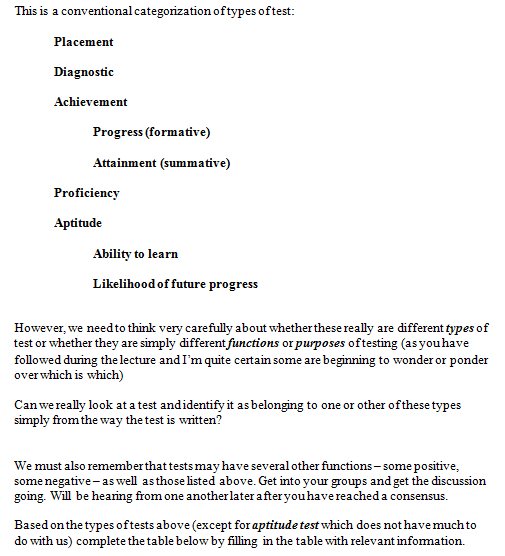
Answers:
Types of Tests &
Purposes
When
Test is Administered
|
Types
of Tests
|
Purpose
of Test
|
Beginning
|
Placement
|
Used to enable teachers to
sort students into groups/ classes according to their language ability at the
beginning of the course.
|
Diagnostic
|
Used to help check students’
progress for specific weaknesses and problems they may have encountered so as
to help teachers to teach effectively.
|
|
Aptitude
|
Used
to predict the success or failure of students
prospective
in a language-learning programme. It
is Usually
used as a screening instrument in langange
testing
|
|
During
(Formative)
|
Achievement:
Progress (Formative)
|
Used
to find out how well the students have mastered the language areas and skills
which have just been taught.
|
End
(Summative)
|
Achievement
: Attainment (Summative)
|
Like
progress test but it is usually designed to cover a longer period of learning
than a progress test and is usually given at the end of the school year/the
course.
|
Proficiency
|
Used
to measure how suitable candidates will be for performing a certain task or
follow a specific course.
|
Comments on Youtube Video
TUTORIAL TASK (Week 1):
Give your
thoughts on what was significant to you in the assessment used in the Youtube
video.
As much as I am amazed at how much alternative
assessments are being carried out overseas and of how effective the results are
(and would like to share on alternative assessment as well), I would like to
just highlight on one or two points which I think have not been touched on so
far. (trying to spice things up here… ;) ). What I am interested to say here is
that besides showing examples of how alternative assessments are being carried
out, the video also points out that all these assessments should be done with
at least some clear objectives, standards and/or criteria. In other words, we
do not just do it anyhow we like to, just do it because we feel we like it or
because this is the government’s new policy. Instead we should be looking at
the rubrics of the assessment as how Anderson (1998) put it. And these rubrics
or these learning objectives have to fit in, if possible nicely, with the
curriculum set by the Ministry of Education.
Secondly, we have to document
the evidences on what that the students have done throughout the year and even
years as in the video. This is to show that “you [the students] learn something
substantial and significant that relates to school curriculum” (Dr. Wiggins,
Grant). I think that multimedia portfolios like the ones done in the video are
one good way to go. I believe these are some of the extra points that we need
to pay attention to as well seeing that most of us would probably be those who
are to implement these alternative assessment at school in a few years time.
Thirdly, I wish to post a
question that we could perhaps discuss about as well. Seeing that we all have
agreed on alternative assessment thus far, and hence against traditional
assessment, let me just ask “Is it a choice only between traditional and
alternative assessment or could the two actually complement each other?”
Because at the end of the day, a high quality local assessment [alternative
assessment] does indeed prove to support a higher test score (Dr. Wiggins,
Grant).
Comment on Anderson (1998)
TUTORIAL TASK (Week 1 & 2):
Having read Anderson's
article, what's your take on her argument 'from traditional assessment to
alternative assessment in HE'. Give your reasons for the stand taken.
 After having read Anderson’s (1998)
article, I found the arguments very true as this is the real situation that is
happening out there right now. First and foremost, I agreed with Anderson’s
point that it is high time for a shift from traditional assessment to
alternative assessment. There are three points that I would like to briefly
comment on here, i.e. (1) the considerations of each learner’s needs, (2) how
ready would alternative assessment equip learners to face the real world
demands and challenges and, (3) the role of the teacher.
After having read Anderson’s (1998)
article, I found the arguments very true as this is the real situation that is
happening out there right now. First and foremost, I agreed with Anderson’s
point that it is high time for a shift from traditional assessment to
alternative assessment. There are three points that I would like to briefly
comment on here, i.e. (1) the considerations of each learner’s needs, (2) how
ready would alternative assessment equip learners to face the real world
demands and challenges and, (3) the role of the teacher.
Based on
Anderson (1998), I found out that alternative assessment takes a more thorough
consideration of the needs of every individual, especially on the part of the
learners, in terms of their learning, improving, interests and goals. As
compared to traditional assessment, learners are given more opportunity and
empowerment in deciding what they are interested to learn, how they wish to
learn a subject, and how they hope to be evaluated. This time round, they are
not only providing suggestions but instead have their suggestion heard and be
carried out, if not in full, to a certain degree. This allows students to
generate a more self-regulatory learning and to approach the topic from their
respective styles of learning and multiple intelligence.
 In other words, alternative assessment promises a better approach in
terms of equipping learners to face the real world challenges, needs and
demands, perhaps even immediately, upon graduation from school- something which
traditional assessment has never seen to be able to do in full up the this
moment in time. The reasons as to why the former fulfills this role is that it takes
into consideration of both the product and the process while only the product
is emphasize in the latter. Thus, the how’s and why’s of learners’ efforts in
achieving and producing the product is being valued and assessment, allowing
them to score in the process as well as the product. Hence, they will also feel
that their credentials and hard work are acknowledged.
In other words, alternative assessment promises a better approach in
terms of equipping learners to face the real world challenges, needs and
demands, perhaps even immediately, upon graduation from school- something which
traditional assessment has never seen to be able to do in full up the this
moment in time. The reasons as to why the former fulfills this role is that it takes
into consideration of both the product and the process while only the product
is emphasize in the latter. Thus, the how’s and why’s of learners’ efforts in
achieving and producing the product is being valued and assessment, allowing
them to score in the process as well as the product. Hence, they will also feel
that their credentials and hard work are acknowledged.
Furthermore, learning is also viewed as an active collaborative process
when it comes to alternative assessment. Therefore, learners are ‘forced’ to
learn about teamwork, team management, organization, task delegation and
decision-making. These are all the ‘on-the-look-out’ points of major companies
today.
 |
| It reads 150cm. |
As for the teacher, her role here is only as a facilitator to learning
instead of being a dictator to learning. In other words, more empowerment would
be given to learners and the teacher should not have full say in everything
(activities, syllabi, assessments) done in class anymore. Thus, a teacher is
also now a learner, learning from the ideas and development of their students.
** To read on Anderson (1998), please click here **
** To read on Anderson (1998), please click here **
Subscribe to:
Posts (Atom)